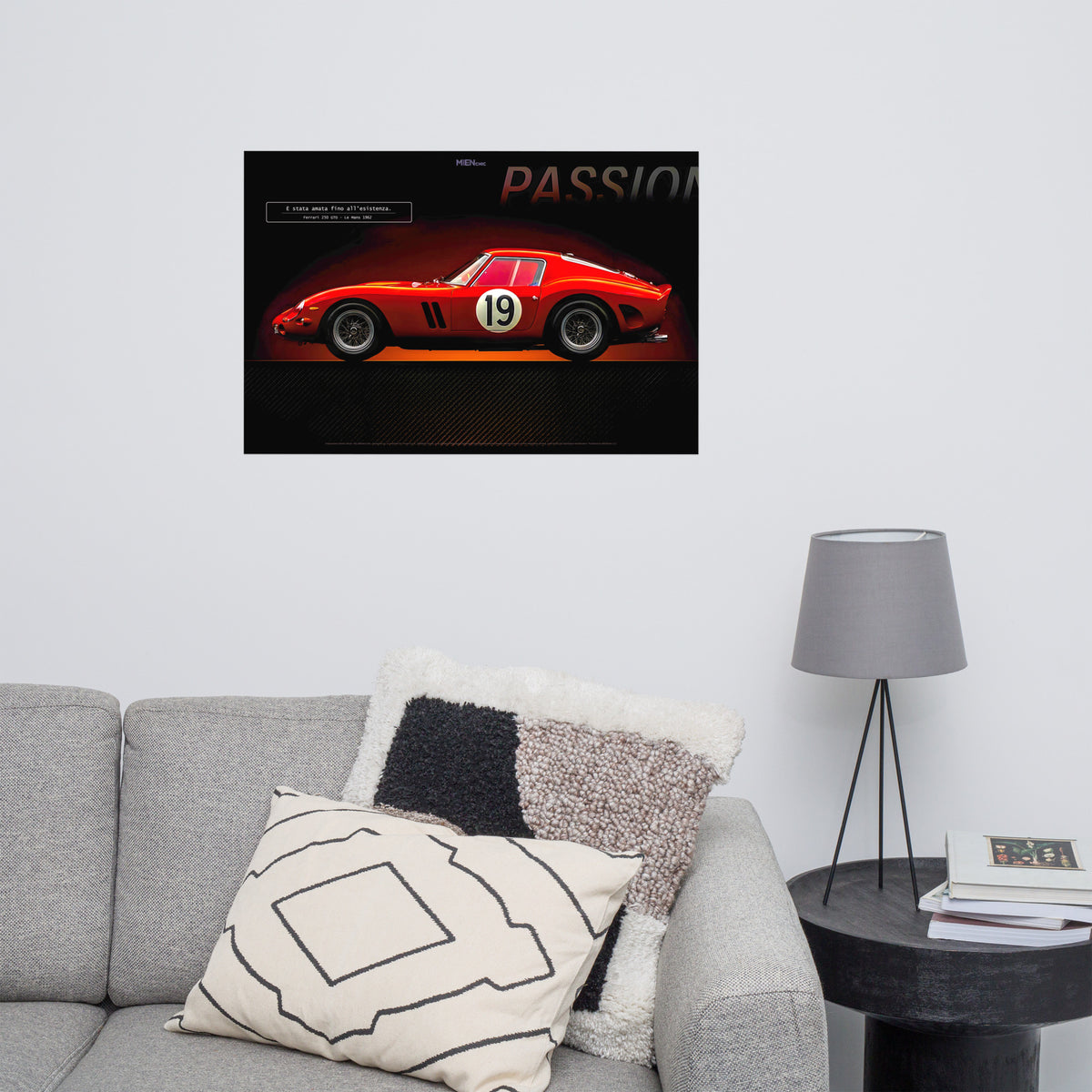
CAVALLO by MIENchic — Ferrari 250 GTO 1962 | 1-of-5 Series - PASSION | 24" x 36" Poster
CAVALLO by MIENchic — Ferrari 250 GTO 1962 | 1-of-5 Series - PASSION | 24" x 36" Poster
Couldn't load pickup availability
PASSION
Ferrari 250 GTO — Le Mans 1962
ONE WORD. THIRTY-SIX CHASSIS AND ONE SOUL.
- The world still believed racing cars were built with slide rules and wind tunnels and cold mathematics.
Then Ferrari unveiled the 250 GTO.
Gran Turismo Omologato.
Homologated for Group 3 GT racing. Thirty-six chassis. That's it. Thirty-six.
Not a production car. A prayer made of aluminum and steel and twelve cylinders and the kind of obsession that only exists in Modena.
Giotto Bizzarrini. Sergio Scaglietti. Enzo Ferrari.
Three men. One vision.
Bizzarrini — the engineer who understood that air is not an obstacle, it's a medium. He shaped the nose to kiss the wind. He lowered the roof. He raked the windshield. He carved the Kamm tail. Every millimeter served the wind.
Scaglietti — the artisan who didn't build bodies, he sculpted them. Hammer on aluminum. Hour after hour. Panel after panel. No two GTOs exactly alike because no two hammer strikes are identical. The seams. The curves the signature of the man who made them.
Enzo — the Old Man. Il Commendatore. He didn't design it. He didn't build it. He willed it. He looked at the regulations and saw a loophole. He looked at the competition and saw weakness. He looked at his men and saw passion.
And he bet everything on it.
The 3.0-liter Colombo V12. Three hundred horsepower at 7,400 RPM. Six Weber carburetors breathing like the lungs of a thoroughbred. The sound — that sound. Not an exhaust note. A hymn. Twelve cylinders firing in perfect sequence, each explosion a prayer to the god of speed.
Six Weber throats inhaling the Sarthe air.
Le Mans, 1962.
Pierre Noblet. Jean Guichet. Privateers. Not factory drivers. Not factory support. Just two Frenchmen who loved the car enough to race it at the world's cruelest circuit.
They didn't win overall.
They won their class.
And they won something more important —
they proved that a car built with passion could stand toe-to-toe with the prototypes and the factory efforts and the unlimited budgets.
The GTO finished second in class at Le Mans in '62. Then won the Tour de France Automobile. Then won the Tourist Trophy. Then won the Nürburgring 1000km. Then won the GT championship three years running — 1962, 1963, 1964.
Three consecutive FIA GT Manufacturers' Championships.
Against Porsche. Against Jaguar. Against Aston Martin. Against the full might of the automotive world.
With a car built by hand. Driven by heart.
But here is the truth about the 250 GTO.
It wasn't the fastest.
It wasn't the most powerful.
It wasn't the most advanced.
It was the most loved.
Every mechanic who turned a wrench on a GTO loved it. Every driver who climbed into the tight cockpit loved it. Every spectator who heard that V12 scream past the grandstands loved it. Every child who pasted a GTO poster on their bedroom wall loved it.
Enzo Ferrari didn't build a race car.
He built an object of desire so powerful it transcended racing.
Sixty-two years later.
A 250 GTO sells for fifty million dollars. Seventy million. The most valuable car in the world.
Not because it won Le Mans.
Because it makes people feel something.
Every time someone sees a GTO — really sees it — something shifts in their chest. The line. The sound. The story. The thirty-six chassis. The three men. The passion.
That is not a race car.
That is a masterpiece that happened to race.
PASSION.
Some cars are built to win.
Some cars are built to be remembered.
The rarest few are built to be loved.
In fact, one could say this about the 250 GTO;
"It was loved into existence."
And it has never stopped being loved.
PASSION— Ferrari 250 GTO, Le Mans 1962 ; Volume I of V — Ferrari Racing Legacy
MIENchic — What you see is yours to see.
Print Specs:
This poster has a partly glossy, partly matte finish and it'll add a touch of sophistication to any room.
• 10 mil (0.25 mm) thick
• Slightly glossy
• Fingerprint resistant
• Paper sourced from Japan
This product is made especially for you as soon as you place an order, which is why it takes us a bit longer to deliver it to you. Making products on demand instead of in bulk helps reduce overproduction, so thank you for making thoughtful purchasing decisions!
Disclaimer: This product is an independent artistic creation, historical tribute, and artistic expression. It is not manufactured, licensed, endorsed, or approved by, nor is it in any way affiliated with Ferrari S.p.A., Scuderia Ferrari, or any of their subsidiaries, racing divisions, or affiliates. All trademarks, corporate logos, manufacturer names, and specific model designations appearing within the artwork or description (including "Ferrari") remain the exclusive property of their respective trademark holders. They are utilized here strictly under the doctrines of nominative fair use and artistic expression to provide an accurate historical description of the real-world subject matter depicted.
Share