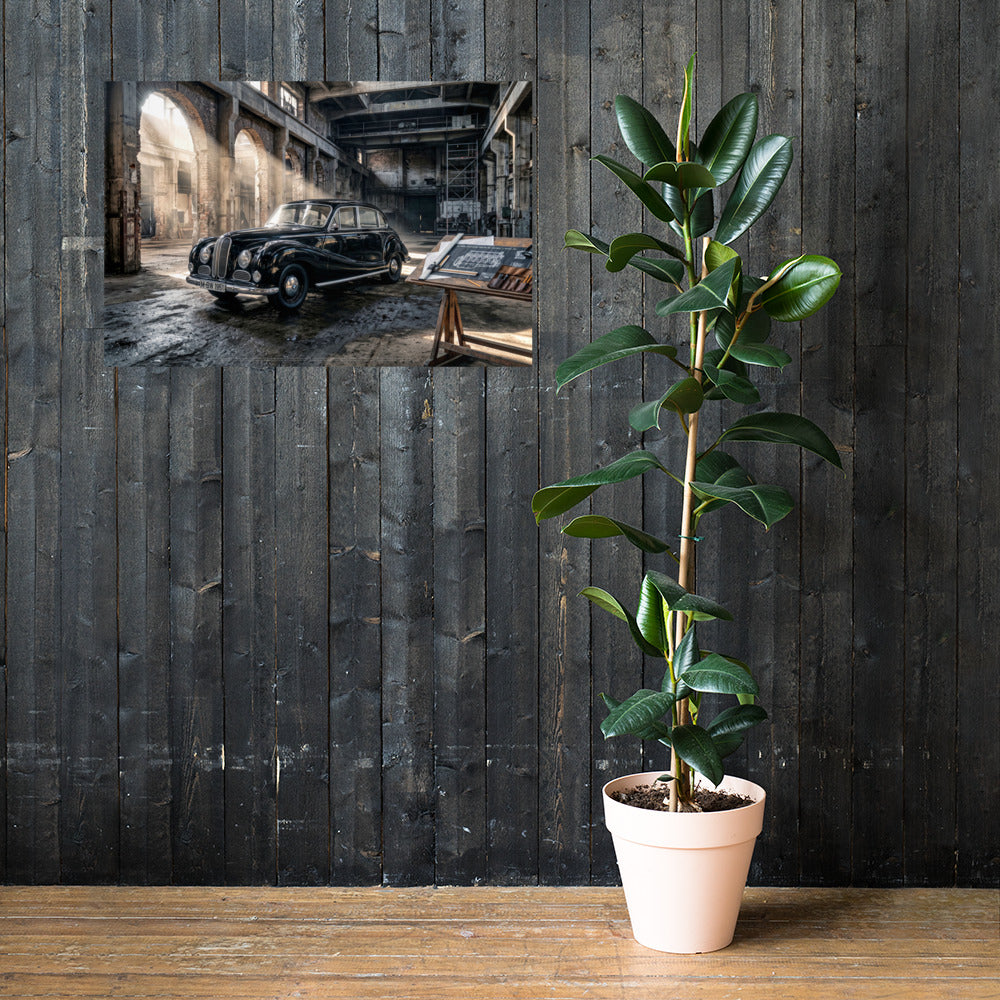
MIENchic — RAPP TO REBIRTH - VOLUME III — How the Art Won. | BMW 501 Baroque Angel 1951 | 24" x 36"
MIENchic — RAPP TO REBIRTH - VOLUME III — How the Art Won. | BMW 501 Baroque Angel 1951 | 24" x 36"
Couldn't load pickup availability
How did the Art Win?
They didn't restart the assembly lines with a new design trend.
They had to steal their own identity back from the ashes.
This print records the desperate, defiant resurrection of the Munich grids: the 1951 BMW 501.
Following the surrender in 1945, the legal headquarters of the brand in Munich was reduced to a pile of rubble.
Act I (The Versailles Era, 1919):
Banned from aviation manufacturing by the Allies after the first war, Max Friz led a desperate fight for factory survival, engineering immediate mechanical creations like industrial truck motors, train brakes, and the legendary 1923 R32 Boxer motorcycle.
Act II (The Yalta/Potsdam Era, 1945):
Crushed once again in the second war, BMW was subjected to extreme industrial humiliation—banned from building vehicles entirely and forced to stamp out kitchen pots and pans from scrap metal just to keep the remaining workers alive.
The Soviets had seized the actual automotive factories and pre-war tooling in the East (Eisenach), the American zone was anchored in the West (Munich), and the British had navigated away with the original engineering blueprints.
Munich had the name, but they had absolutely no memory.
To rebuild, they had to look backward.
Under the architectural memory of a retired Max Friz, a rogue cell of Munich engineers gathered in a cleared corner of the ruined factory. Leading the mechanical extraction was Baron Alexander von Falkenhausen—the pre-war chassis wizard who co-designed the legendary 328.
Falkenhausen didn't have blueprints; he had intuition.
By reverse-engineering surviving components and analyzing pre-war metallurgy, he resurrected the iconic 2.0-litre straight-six heart from absolute scratch, designating it the M337.
They wrapped this reengineered core inside a voluptuous, hand-formed steel sedan shell so sweeping and dramatic it was instantly christened "The Baroque Angel."
It was the first car built entirely on Munich soil—and the final stand of the ancestral lineage before Falkenhausen transitioned the factory floor to birth the high-tech laboratories of the modern "M" division.
You can burn the blueprints,
but you cannot kill the frequency.
"The art won."
From Angels to Batmobiles
BMW 501 Baroque Angel 1951 — RAPP ROOTS
by MIENchic — What you see is yours to see.
This poster has a partly glossy, partly matte finish and it'll add a touch of sophistication to any room.
PRINT SPECS:
• 10 mil (0.25 mm) thick
• Slightly glossy
• Fingerprint resistant
• Paper sourced from Japan
This product is made especially for you as soon as you place an order, which is why it takes us a bit longer to deliver it to you. Making products on demand instead of in bulk helps reduce overproduction, so thank you for making thoughtful purchasing decisions!
Disclaimer: This product is an independent artistic creation, historical tribute, and expressive visual publication produced entirely by MIENchic LLC. It is not manufactured, licensed, endorsed, or approved by, nor is it in any way affiliated with Bayerische Motoren Werke AG (BMW) or any of its subsidiaries or historical divisions. All trademarks, historic model designations, and engine codes appearing within the artwork or written descriptions (including "BMW", "501", and "Rapp Motorenwerke") remain the exclusive property of their respective trademark holders. They are utilized here strictly under the legal doctrines of nominative fair use, descriptive historical reference, and protected First Amendment artistic expression to accurately document real-world automotive history. All online backend storefront brand metadata fields remain registered solely under the independent studio name.
Share