MIENchic — RAPP TO REBIRTH — FORGOTTEN PHANTOMS | The High-Altitude Legends of The Bavarian V12 | 24" x 36"
MIENchic — RAPP TO REBIRTH — FORGOTTEN PHANTOMS | The High-Altitude Legends of The Bavarian V12 | 24" x 36"
Couldn't load pickup availability
Asphalt to Altitude
The treaties signed in the ashes of the Great War intended to bury the blueprints forever.
They banned the foundries.
They shuttered the hangars.
But they could not erase the geometry.
This print exposes the ultimate, global climax of a forgotten lineage. Long before West Germany could legally build an aircraft engine again, before the rise of the Nazi party, Germany was desperately trying to keep its engineers employed, and international companies were just doing business. So, the core engineering architecture forged on Karl Rapp's Munich factory floor had scaled up, doubled its cylinders, and mutated into a fire-breathing V12 superpower.
This was not a case of back-alley espionage, but an extraordinary peacetime paradox.
During the brief, roaring window of the 1920s Weimar era, BMW legally licensed its massive BMW VI V12 engine to foreign powers hungry for industrial baseline tech. By mating two symmetrical cylinder banks onto a single crankshaft at a 60-degree angle, the blueprints for an aviation masterpiece were legally sold, exported, and established across global borders.
But peace is temporary, and geometry cannot be policed.
When the geopolitical fault lines ruptured, these identical twin architectures were instantly drafted into opposing empires, transforming into the forgotten phantoms of World War II.
One Blueprint. Two Nations. An unseen absolute design hegemony.
A Confrontation of Mirrored Metallurgy
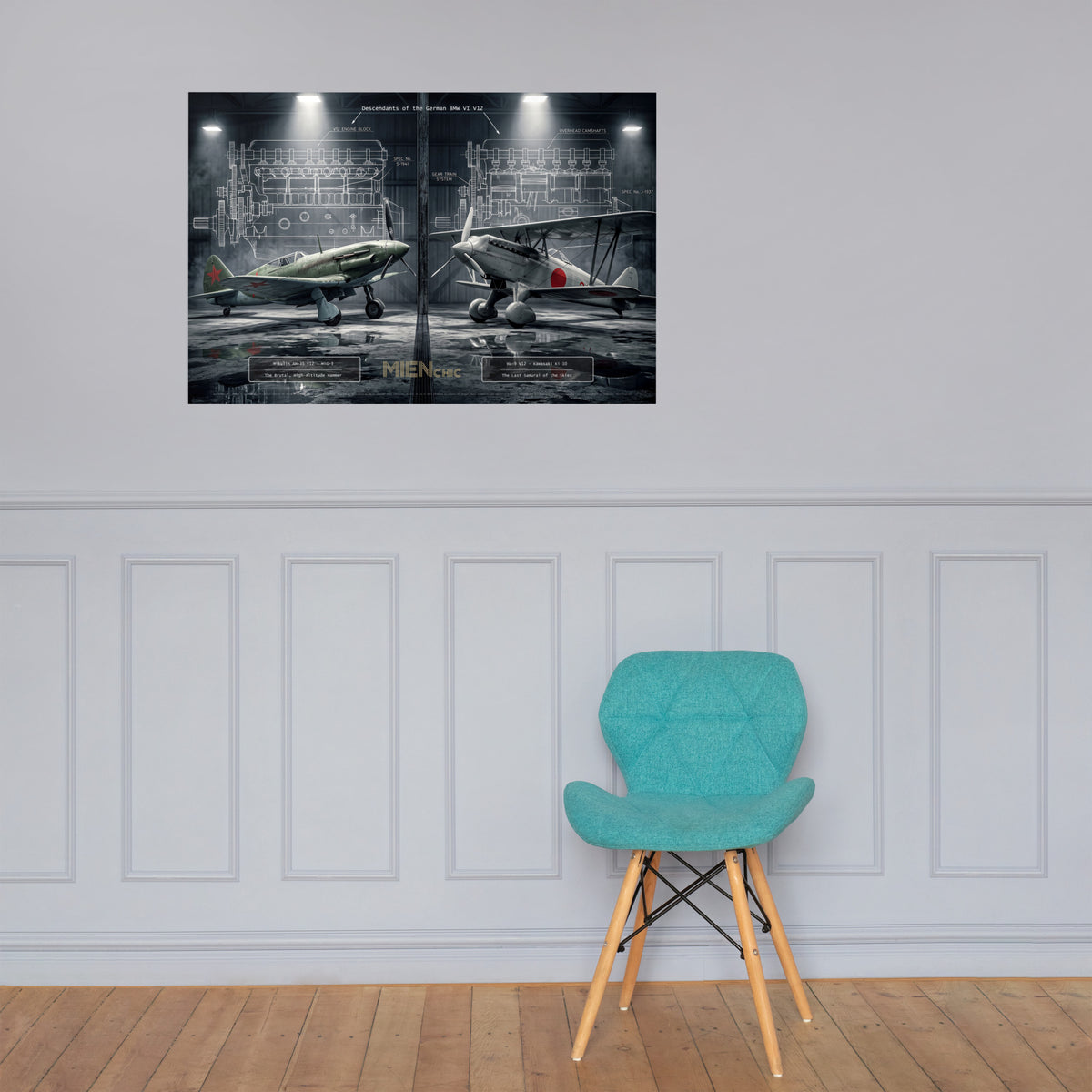
This print captures the grand, quiet tension of an invisible lineage. Brought face-to-face on the wet concrete floor of a dark, atmospheric military hangar, two legendary war machines look directly into their own mechanical reflection. Strip away the paint, the cowlings, and the language stamped on the data plates, and a mechanic would find the exact same mechanical heart humming at the exact same frequency.
To the Left: The Red Star Interceptor — The Brutal, High-Altitude Hammer
The 1941 Soviet MiG-3. A razor-sharp, low-wing interceptor built by the Mikoyan-Gurevich design bureau to defend Moscow's skies. Built under a legitimate pre-war tech agreement, the Soviet Union mass-produced the architecture as the Mikulin M-17 line. Soviet engineers pushed the design to its absolute physical limit, evolving it into the high-compression AM-35 [Spec No. S-1941]. The Soviet pilots climbing into the thin, freezing air of the stratosphere to hunt the Luftwaffe were riding a weapon dragged into the sky by an engine tracing its dimensions straight back to Bavarian blueprints.
To the Right: The Rising Sun Fighter — The Last Samurai of the Skies
The 1937 Japanese Kawasaki Ki-10. The pristine, ultra-agile biplane fighter that served as the cornerstone of early air power in the Far East [Spec No. J-1937]. Seeking a proven baseline for specialized manufacturing, Imperial Japan legally secured the engine blueprints from BMW. Kawasaki Heavy Industries cast the design in their own foundries to create the Kawasaki Ha-9. Preserving Max Friz's signature overhead-camshaft mechanics and Rapp's original factory structural dimensions, this liquid-cooled V12 was encased in a slim, sharply pointed nose—becoming the mechanical backbone of Japan's early army air forces sweeping across the Pacific theater.
The Ultimate Historical Twist: The Loop Closes
But history does not care about corporate pride. While the East and Far East were fighting separate wars powered by German-licensed DNA, a massive, ironic turnaround was happening back in Munich.
By the late 1920s, BMW's own engine technology had fallen behind.
In 1928, in that exact same window of global trade, BMW signed a completely legal commercial licensing agreement with the American company Pratt & Whitney to build their civil passenger engines.
When the tides of the 1930s turned back toward conflict, Germany did exactly what the rest of the world had done to them: they weaponized the blueprints. They took the American Pratt & Whitney radial engine architecture, upgraded it, and rebranded it into the BMW 132—the exact engine that would power the backbone of the German Luftwaffe.
The Verdict
They flew under different flags.
They fought in different theaters.
They catered to entirely different empires.
But thousands of feet above the earth, where the air grew thin, the war machines of the world relied on the exact same structural blueprints.
A globally distributed manufacturing legacy, operating in plain sight.
And no one was the wiser.
The High-Altitude Legends - Asphalt to Altitude, full circle.
The Bavarian V12 — RAPP TO REBIRTH
by MIENchic — What you see is yours to see.
This poster has a partly glossy, partly matte finish and it'll add a touch of sophistication to any room.
PRINT SPECS:
• 10 mil (0.25 mm) thick
• Slightly glossy
• Fingerprint resistant
• Paper sourced from Japan
This product is made especially for you as soon as you place an order, which is why it takes us a bit longer to deliver it to you. Making products on demand instead of in bulk helps reduce overproduction, so thank you for making thoughtful purchasing decisions!
HISTORICAL NOTE
The aircraft depicted—the Soviet Mikulin AM-35-powered MiG-3 and the Japanese Kawasaki Ha-9-powered Ki-10—represent two distinct paths of global aviation evolution. While structurally unique to their respective nations, both engines were heavily developed "descendants" derived from early licensing agreements and structural blueprints of the German BMW VI V12 engine. All diagrams and specifications are reconstructed for narrative purposes based on historical variants.
Disclaimer: This product is an independent artistic creation, historical tribute, and educational reference publication produced entirely by MIENchic LLC. It is not manufactured, licensed, endorsed, or approved by, nor is it in any way affiliated with Bayerische Motoren Werke AG (BMW), Mikoyan-Gurevich (MiG), Kawasaki Heavy Industries, Pratt & Whitney, or any of their modern corporate successors, subsidiaries, or affiliates. All trademarks, historic model designations, military aircraft designations, and manufacturer names appearing within the artwork or descriptions (including "BMW", "BMW VI", "BMW 132", "MiG-3", "Kawasaki Ki-10", "Ha-9", "Mikulin M-17", "AM-35", and "Pratt & Whitney") remain the exclusive property of their respective trademark holders. They are utilized here strictly under the legal doctrines of nominative fair use, descriptive historical reference, and protected artistic expression to accurately document real-world aviation and industrial history. All digital backend storefront tags remain registered solely under the independent studio name.
Share